Introduction by Jessica Joy Schipper | Interview by Robin Pailler | Photography by Lucie Bascoul
Marsi Van de Heuvel’s paintings delve into personal and collective histories, reflecting on the subject of belonging, memory, and visibility.
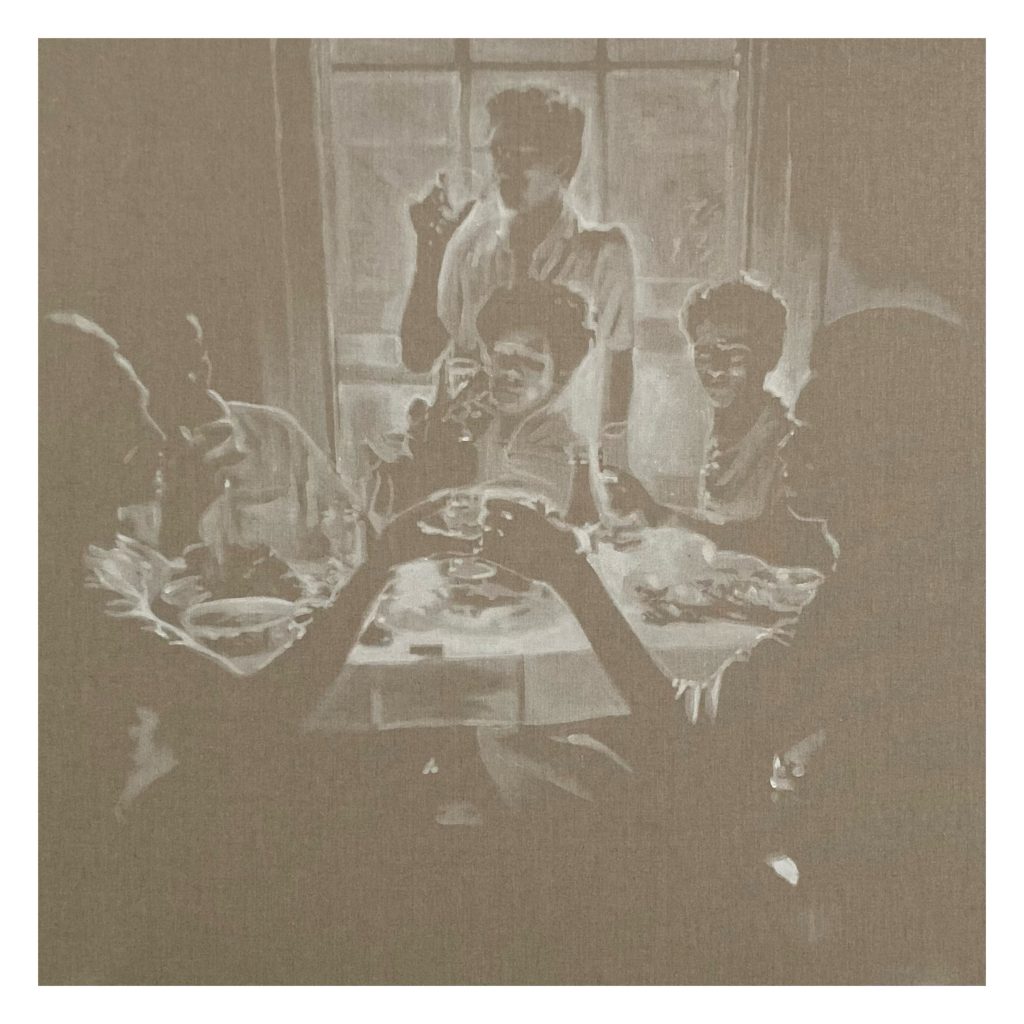
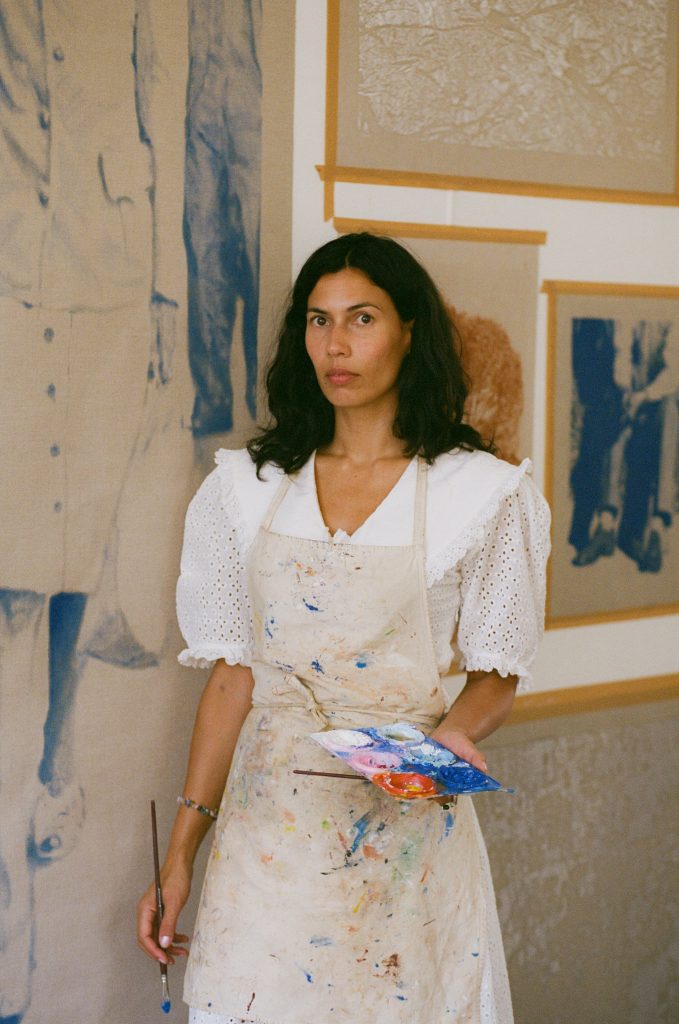
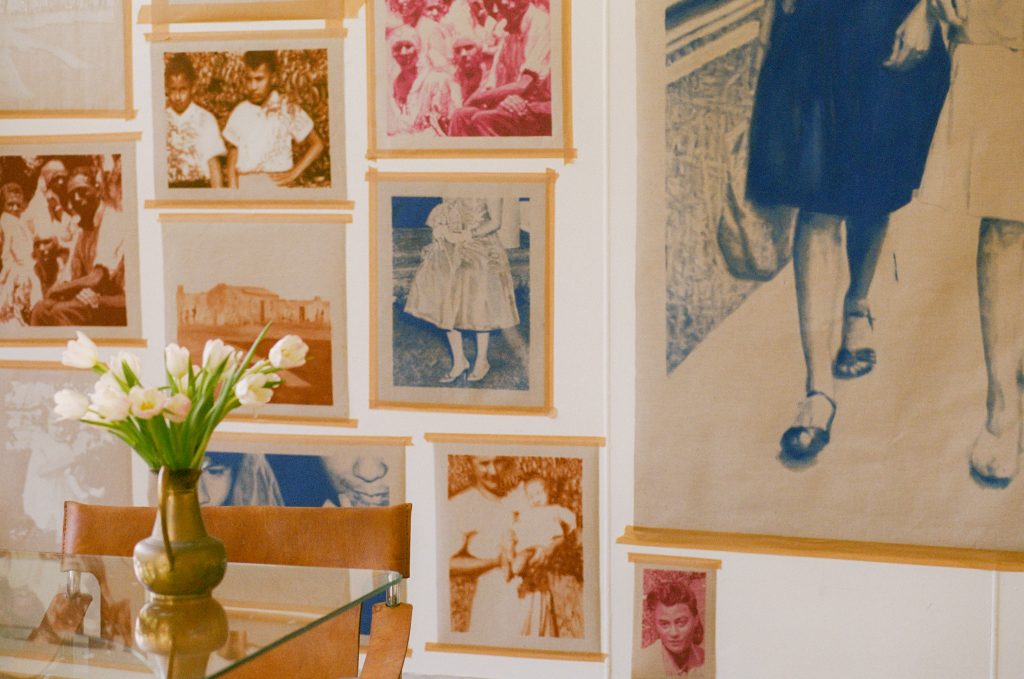
Her ongoing series, Skoonveld translates as “clean field,” referring both to land emptied through forced removals during apartheid and to the systematic erasure of the history and culture of people classified by the regime as “coloured.” This body of work addresses precisely that void: a space marked by expulsion, denial, and the distortion of identity. Drawing on a collection of photographs taken by her maternal grandmother and other family members, Marsi’s work investigates the construction of belonging and memory. The images, which document scenes of domestic and school life, but also special occasions such as weddings, function as gestures of affirmation in the face of a dominant narrative that portrayed these communities as inferior. In them, families present themselves as they wished to be seen: dignified, affectionate, and complex. The emphasis on details (gloved hands, a carefully held handbag) highlights strategies of respectability and self-assertion in response to racist labelling. Through oil paint and other media, Marsi destabilises stereotypes inherited from apartheid.
Can you tell us a little bit about your upbringing in South Africa?
I grew up in a place called Kraaifontein, just outside of Cape Town. It was a ‘coloured’ neighbourhood, where my family were moved to after their homes were taken from them by the apartheid regime.
I was seven in 1994 when apartheid ended. You can still clearly see segregation in the infrastructure across South Africa today. But what I could see from a young age, was the contrast between the home where I grew up, and where I went to school. My mother was a teacher at a private Christian school in Durbanville, which was an area for white people at the time. The only reason I had access and could attend that school was because my mother worked there, otherwise we would have never been afforded that level of education. This meant that everyone else that I was in school with had a very different home situation and I didn’t quite fit in with the other kids in my neighbourhood, because I went to a different school, it was strange. I think it’s partly why my art continually deals with the idea of belonging and what that means, because I grew up in between these opposing spaces.
How has growing up in that environment shaped you as an adult today?
I feel that there were things that I was taught to do, I guess, for women in general there always were expectations of being quiet and polite, and in the way you present yourself. Then there was naturally another layer to that, given where I came from, that I felt like there was an expectation for me to not show sadness or ever be angry – an expectation to always be happy and grateful. As a young teenager, I started waking up to what these expectations meant and where they came from. I think the adults in my life thought I was a bit naughty and rebellious as a teenager even though I know I didn’t do anything particularly rebellious, but I disagreed with the status quo. I wasn’t a bad kid, I just wanted to be independent and live a different life.
I left my family house when I was 15 because I wanted independence. I think that leaving home at that young age affected my work ethic and how I spend my energy.
How did you get into art? Where did that all begin?
My mom was an art teacher at the school I went to, so I always had access to materials and books and that’s just how I would spend my time. I was just always making stuff. There wasn’t really an example for me at the time of someone like me… No one I could see, like me, in the art books and I think maybe that ‘rebellious’ side of me immediately was inspired to want to take up space there, like, why not?!
At what point did you go to art school? When did you decide to take the academic route on that?
I studied part-time while I was still in high school. I studied photography at night, and assisted a photographer after school (which helped me decide photography wasn’t exactly the right field for me). I wanted less limitations, which led me to study further at Ruth Prowse School of Art.
 Who were your key influences growing up?
Music has always been a big influence for me. Seeing Brenda Fassie performing on TV helped change my perception of the expectations of women for sure. She was wild, free, bold, just truly remarkable. We called her South Africa’s Madonna.
Steven Cohen, a different kind of a performance artist, has constantly tested boundaries of sexuality and politics in a mind-blowing way. But I think the first time I saw someone that looked like me and making artwork, was seeing Bernie Searle at the National Museum as a student. She made work about identity using spices; it definitely resonated and left an impact.
I want to ask you, what the challenges of being an artist, not only in South Africa, but as a female in South Africa, within the art world are? Do you feel like you’ve had to fight extra hard?
I feel like statistically things are starting to change. More visibly equal representation in South Africa, and the rest of the world, is becoming more apparent. Women are taking up more space, but generally, when I was a student and while growing up, it was a space that was mostly filled by men. I think that people are finally giving more attention to women and black and brown voices in general.
It’s not really a logical choice to become an artist. Especially if you don’t come from a background with financial stability or support. That said, I’ve also never really done anything else, so I think that, working hard and being devoted to this thing feels like it’s kind of paying off. I love that I can explore anything with art, and it feels meaningful, which is cool.
Can we talk about the relationship between art and politics and is that a conscious choice? Or do you just feel like that’s due to your upbringing, your surroundings?
The first body of work that I made after art school, I feel was indirectly informed by themes of belonging and identity. I drew outer space for like three years. The thought of space and the universe made me feel very small with the anxieties surrounding what it is to belong. Life feels so precious in that bigger picture. I think politics is in everything. Just taking up space and choosing, just being, making anything is political, inherently.
Do you agree that sometimes within the art world, as a whole, people are political for the sake of it, because they think it’s performative…
Yeah, sometimes political art can give me the ick. If it feels like virtue signaling. I think that if you’re screaming your point of view to someone, you’re not going to change their mind, communicate or connect. I try and make things that are beautiful and captivating with a subtle approach of getting the message through. Like if you whisper something, people have to lean in to hear more but if you’re screaming it, I think it often has the opposite effect.
Recently I placed a vintage, wooden school desk in a gallery space which you can sit at and do a rubbing, a frottage, that reads “I belong here”. It was part performative, because I sat and made a whole bunch of rubbings that the viewers could take with them to keep. Or the viewer could sit and make their own rubbing if I wasn’t there. So, it became interactive and a physical found object that is still performative. I like bringing more sculptural elements to a show because I think it makes the space itself feel more alive and gives a different context or sense of life to the paintings.
Honestly, I make paintings because I love them but also because they’re sellable works. It’s unlikely that someone is going to buy an old school desk, it’s a harder thing to keep. But I really enjoy experimenting with other things to add to the exhibition space, that I don’t have to sell.
Where does a start and end point come for a lot of these projects, or is it just continually evolving?
It always starts with an idea that becomes a bit consuming, I’ll do some research and start collecting images. It creeps into conversations with friends and as the concept develops, I find a visual language for it.
I love a deadline, so I try to set one with a gallery once I know what I’m doing and find a way to show it and share it. The gallery and other artist friends usually come for a studio visit or two before an exhibition with fresh eyes and help edit. I try to work on one project at a time, but sometimes I start experimenting with something new and then get distracted by another, so there’s a few ideas in my pocket waiting to be picked up again.
A lot of people reading this might not really know that much about South Africa, and the Purple Hearts Campaign and the heavy threats of gender-based violence in particular.
Yeah femicide in South Africa is beyond bad. Our statistics are really high – five times higher than the global average. There is violence in all kinds of shapes and forms. Someone asked me the other day, what am I most afraid of and I realised that it’s men; which is terrible. Really terrible.
Tell me about the Venice Biennale this year because that was another interesting thing. Am I right in saying that the whole international jury stepped down or resigned?
Yeah, they resigned because of Israel and Russia’s participation. I think what happened was the jury disagreed with Russia and Israel’s participation in the Biennale, and they were left with no choice other than to resign. I’d never been to the Biennale before. Venice is insanely beautiful, feels a bit unreal. The quality of the artwork being exhibited is incredible. That being said, the contrast of the content of the work and the opulence of the Biennale is quite mad. I guess the art world is like that in general. I feel like many artists, curators, and galleries are trying to be sensitive to the times, and it was great to see voices from all over the world. There was a Palestinian protest throughout Venice, that started off very small and then grew into this big thing that was super moving, that said, “No Genocide Pavilion.” It was a very political Biennale. Maybe 2026 was the one to shake things up there and a super interesting year to attend.
I just want to quickly touch upon Skoonveld, the work that you were in the midst of finishing when Lucie and I visited you in studio. Can you just talk a little bit about your approach to that, like the inspiration for that, and how that began, and what that symbolises, and how it’s linked to you personally.
It started after my father’s passing, I was just thinking about his life, even though all the images from Skoonveld are from my mother’s life and her side of the family. The truth is I have no images of my father’s parents or their lives probably because they didn’t have access to a camera. I searched and couldn’t find any photos, and so it felt like this neglected narrative.
There’s so much that we just never spoke about, because I think that there is an inherent sense of shame and I guess with mixing races being illegal in South Africa, for so long during Apartheid, coupled with the trauma of it all, and being displaced from homes… We as a society don’t speak about it enough. I think when ’94 happened, there was some kind of unspoken agreement of “Okay, we just don’t talk about that. It’s done now.” I think that now there’s been enough time from it for us to start unpacking it and I think it’s essential for us to start unpacking it because I can also see how things play out in my own personal life and surrounding community. These learned patterns, the way that you see yourself and the way you see how different people are treated in different ways. Unfortunately, some South Africans are currently perpetuating the hostile, oppressing patterns onto vulnerable foreigners, which goes against our whole post-apartheid ‘ubuntu’ ethos.
So, I started exploring, using images of my mother’s family. I guess being mixed of so many different things also adds more levels to unpacking the idea of belonging. What do I actually belong to? Genetically I’m a mix of more than 30 things, but what land, culture, or beliefs?
So, I began to question “What is it that I actually belong to?” Understanding where I come from and getting context of why my parents are who they are, or why my country is the way it is, has informed and helped me understand who I am and what it is I want to contribute. What I want to give my energy to and what I feel I need to share? Who my community is and what can I make to connect with them?
Do you feel sometimes when you’re doing these artistic projects, it’s a form of therapy in a way?
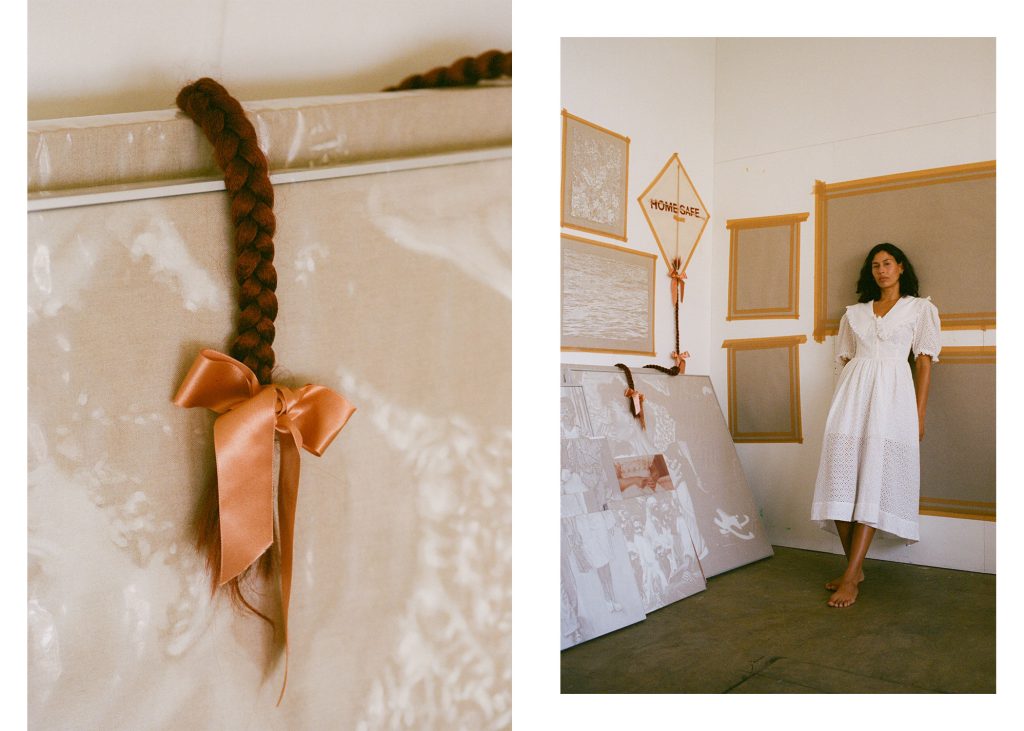
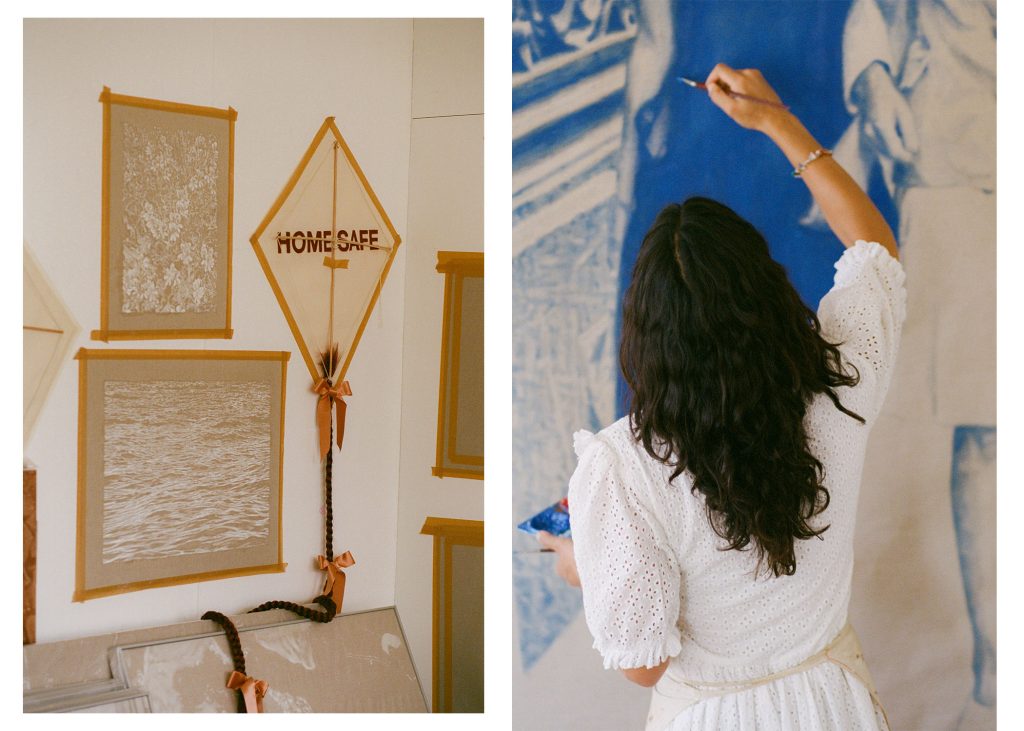
Oh, 100%. After I was painting outer space, I went through this phase of drawing the ocean – I thought of the expanse of water as a connecting body of memory, and made these super meditative, super detailed fine liner drawings that were really soothing. The process and practice are reflective and therapeutic.