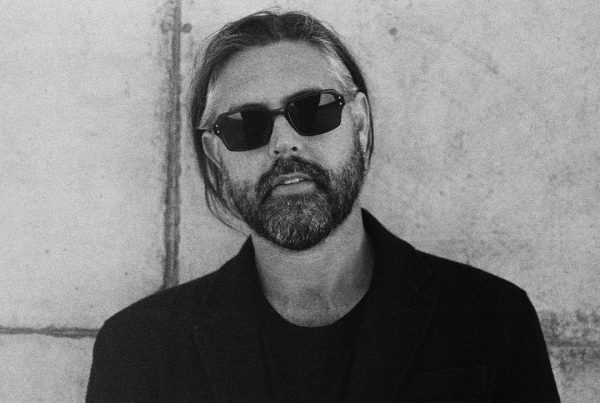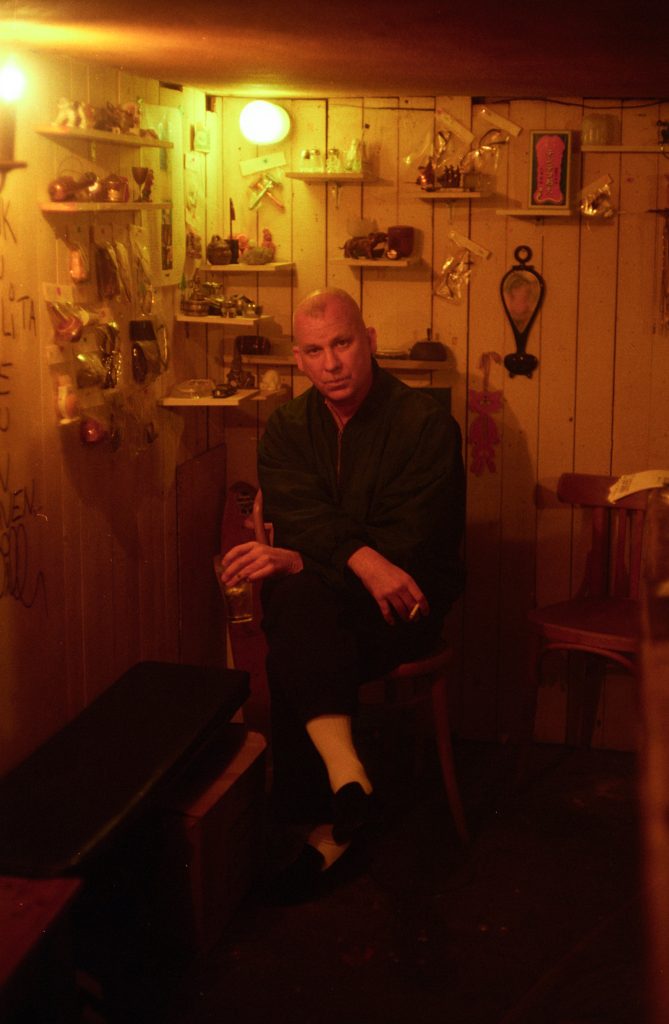
Portrait by Lui Araki | Interview by Robin Pailler | Photography by Greg Hunt
Few figures have navigated the strange intersection of counterculture, commerce and creativity quite like Jason Dill.
For more than three decades, he has occupied a singular place in skateboarding: equal parts iconoclast, entrepreneur, accidental cultural commentator, and reluctant celebrity. The remarkable thing about Dill, however, is that he has never seemed especially interested in remaining the person everyone already knows.
Having spent a lifetime helping redefine skateboarding’s aesthetics and attitude – shaping not just how it looks, but how it thinks and speaks – he has now turned his attention toward a different pursuit: painting. What began as a private obsession over a decade ago has evolved into a serious artistic practice, with sold-out exhibitions across Europe and a growing reputation that extends well beyond the world that first made his name.
Still, the essential Dill remains intact: curious, self-deprecating, voraciously well-read, and deeply sceptical of convention. Equally comfortable discussing contemporary painting, literature, memoir, history, or skateboarding, he possesses the rare ability to make intellectual curiosity feel less like a performance and more like a way of moving through the world. Today, he finds himself in the enviable position of being both a veteran and a beginner – someone who has already lived several lives, yet speaks about painting with the excitement of a man who feels he’s only just getting started.
What led to your self-imposed exile from the US?
I don’t know how long the exile will last, but it’s been almost two years since Adidas asked me if I could have an art show ready for fashion week in Paris in mid-June of 2025. I don’t give a shit about fashion week, but I was happy for the opportunity to do this show for Adidas. It was my first solo show — me by myself with my paintings and drawings and photographs and collages. I had just over four months to prepare for the show. There was nothing in America that I was tied to, so I thought: if I make it on time for the show, and the show does well, I’m just gonna stay in Europe for a while. So I went to Paris, and the show did really well.
I stayed in Paris for a month, and then traveled around — went to Norway and Berlin — and then I ended up in London. I did another small show, thanks to Blondey McCoy, at his studio in London, and that did really well. It felt good to be traveling. Then I had to go back to Germany; I went to the Adidas headquarters in Herzogenaurach, which was incredible. Then I went back to London, and then I flew to Korea. So, I’ve been living between Seoul and Japan since October of 2025.
I guess it just all worked out naturally?
Yeah, I suppose, but I don’t really know what I’m doing — I don’t have a plan. For the moment I just like being on the move, spending a couple of months here and there. I was just back in Japan and took the train all over — I went to so many places I had never been before. The first time I went to Japan was 1994; I have spent so much time there since.
How did the Blondey connection happen?
I’ve known Blondey since he was 15. I always really liked him — felt like somehow I was related to him, felt like his uncle or something like that. He is just so damn sharp and very funny. He makes me laugh, I make him laugh.
But yeah, Blondey asked me if I would do a show at his studio when I was in London, and I gotta say that he really put me on to a few people that I really adore now — people I didn’t know before Blondey asked me to do the show. It was a really great month I spent in London, and Blondey really took care of me.
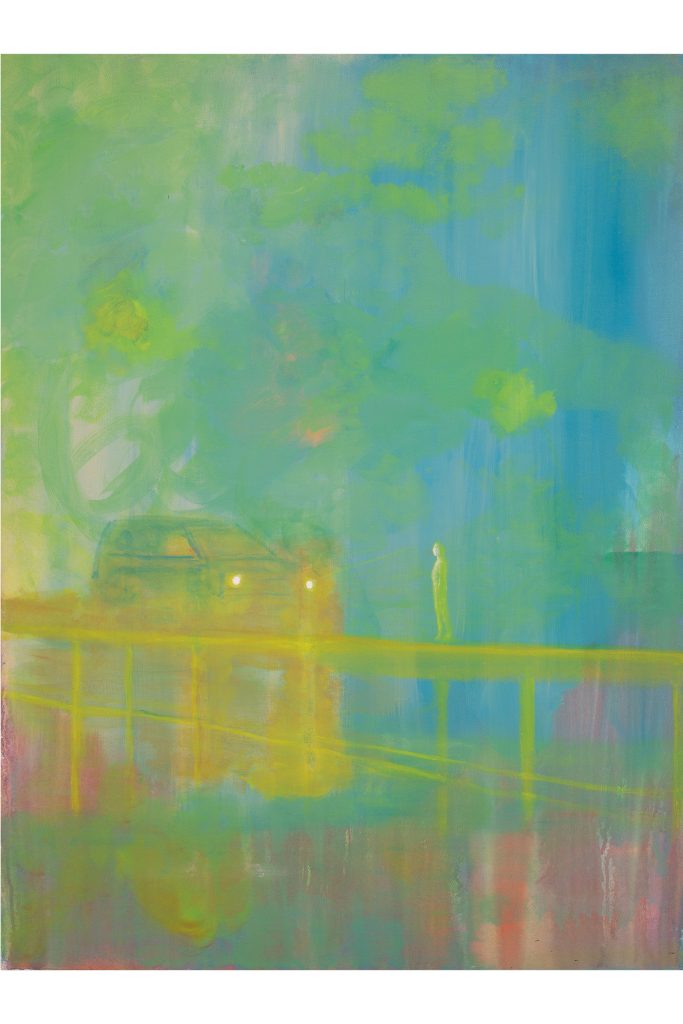
And I remember you telling me in Seoul that you sold everything from that London show?
Yeah, it did really well, and you know that was only my second solo showing, so that was really nice. I am a mixture of surprised and very pleased when people buy my paintings. Sometimes I’m happy with a few of my paintings, and a lot of times I find big faults in most of my paintings — I see what I would change or do differently. But yes, I am very grateful when a show goes well.
I spent most of my life skateboarding, which really opened the world to me, and I’m so grateful for that. As I got a little older, I just wanted to turn the corner and do something else with my time. I love skateboarding. I broke a lot of bones, and I knocked myself out four times on concrete — lots of hospital stays, surgeries, and whatnot. I’m grateful for it — hitting my face, breaking bones — not many people can say that. I’m grateful for the pain and excitement that all those years of skateboarding gave me.
How do you approach painting a big canvas? Where do your ideas stem from?
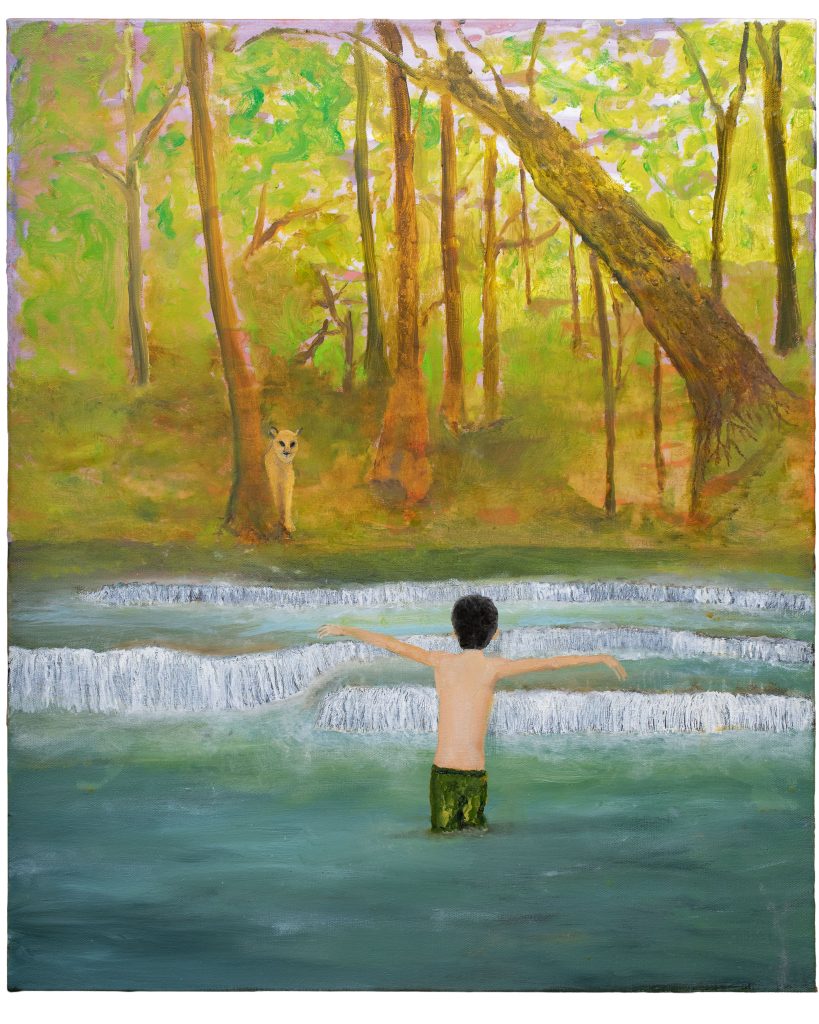
I mainly just paint things that I want to see. Most of the time it starts out with a landscape — I like painting landscapes, painting trees and water and nature. Luckily, when I started, I could really do a funny job painting nature just out of my head, not using any tricks or any stuff like that. I was doing acrylic paintings, and then I moved on to painting in oils and doing bigger ones. In the first few years of my painting, friends of mine who are painters complimented me and said, ‘Hey, this is really cool, I really like what you’re doing, the fact that you don’t know what you’re doing is pretty cool, because there’s certain things that you’ve landed on in these paintings, these early paintings, that because you didn’t know what you’re doing, it works. The way the water looks like that or why that tree looks like that. The leaves and the branches. I wouldn’t do it that way, but it totally works, and you should keep leaning into it.’
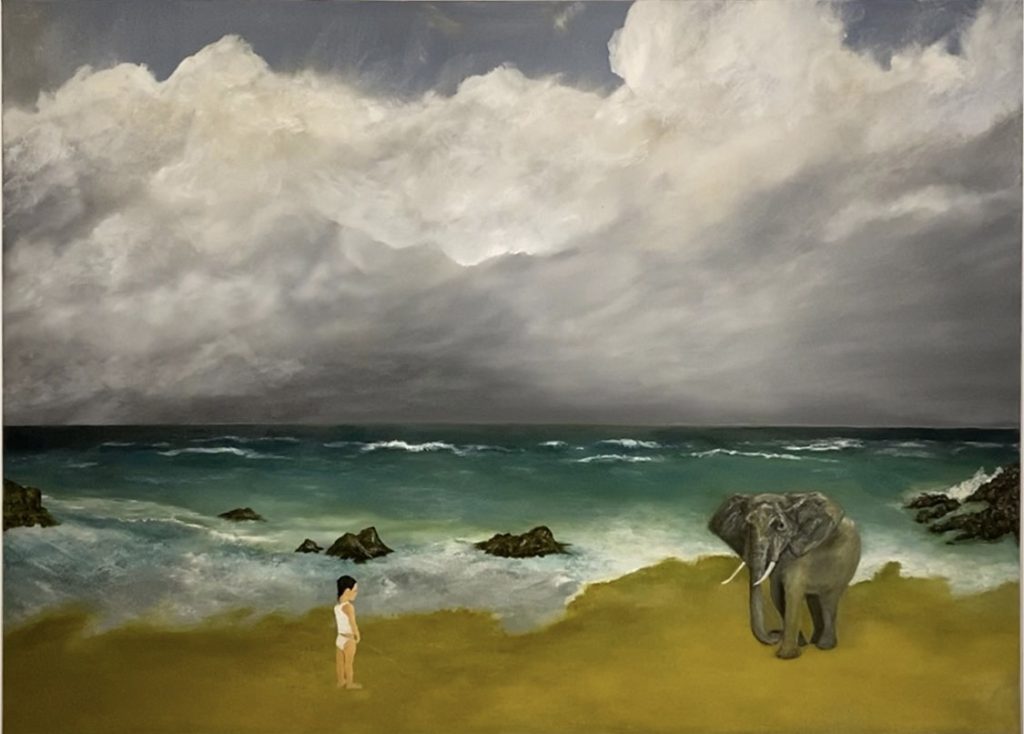
I just went to the Henry Taylor exhibition in Paris and made me wonder who your key influences are when it comes to painting?
I like Henry Taylor. I like him and Kerry James Marshall. I also really love Noah Davis and Cecily Brown. I really like this guy Daniel Richter from Germany. I actually wrote him a letter, and he never responded. I figured he’d probably respond — I don’t know how many letters he gets. But I really like Daniel Richter. His stuff just changes a lot — it’s weird and different.
My ex-girlfriend Chiharu Sei is a great painter. She has been very complimentary of my work — she’s told me, ‘You have a unique style and it keeps changing, and it’s a good thing, just keep it up.’
But I think it’s quite indicative of you as a person, whether it’s you as a skateboarder, or you as the owner of a board company, or you, as a painter, I think you’ve always had a quiet confidence about what you’re doing, and a ‘don’t give a fuck’ attitude.
Oh, I give a fuck — I’m terribly insecure about my paintings.
You’re still somehow really level headed for someone that’s knocked himself out four times, done a lot of drugs, a lot of drinking, a lot of partying. What do you think has kept you level in that sense?
I’m just much more mellow than I was. I’m embarrassed by my rambunctious nature when I was younger — not all of it, but I had fun. I’m grateful I didn’t die; my life as a middle-aged man wasn’t guaranteed, so I’m just happy to be wherever I find myself.
I wanted to talk books, because obviously you’re an avid reader. You mentioned John Lurie’s book to me the other day. You’ve also mentioned to me, in conversations, Christopher Hitchens and Raymond Carver. Are there any books in particular that had a profound effect on you?
I mentioned Christopher Hitchens regarding his book Hitch 22 — Hitchens was quite a polarizing character, but he wrote a great book. Raymond Carver only wrote a few books, and if you look into his personal life, you’ll find a very flawed man. I still very much enjoyed reading his books. There are people who made great art or literature that turned out to be hideous human beings — some, to the extent that I won’t partake in giving them any of my mental capacity. Then there are the flawed humans who made great things, and you can simply take the good and leave the bad. I understand whichever way anyone tends to lean as far as that stuff goes.
But anyway, I like Larry McMurtry, Junot Díaz, Ta-Nehisi Coates, Colson Whitehead, and Zadie Smith. And John Steinbeck — I love John Steinbeck. He’s easy to read; I find his writing to be very upfront, human, and compassionate.
I am fortunate that I like to read. My older brother Chris got me into reading at a very young age — he showed me films like The Outsiders and Rumble Fish and explained to me that these films were based on books written by a very young woman from Tulsa, Oklahoma, named S.E. Hinton. I think that’s where it started — that’s what started me reading. I take a book with me to places where I know I’ll have to wait — airports, trains, restaurants — I sit and read as I wait. It’s a nice way to wait.
I get that.
I tend to always have a book with me. I notice what other humans are doing — they’re looking at their phone, that’s fine, they’re ascertaining information, they’re doing whatever they’re doing, and that’s the modern world. Of course, at times I also find myself looking at the phone; I try not to do it too much. I just really enjoy reading. Right now I’m reading a book called Human Acts by the Korean author Han Kang.
Salman Rushdie, the guy who wrote Satanic Verses — the Shah of Iran put out the fatwa on him to be murdered because of that book. Satanic Verses is probably the most difficult book I’ve ever read. It’s completely ridiculous. I read it a few years ago. It’s insane. That being said, I just read his latest book called Knife, and it’s a true story of how he was attacked by a young man on a stage in upstate New York at a university right as he was about to give a speech.
I remember that. Didn’t he lose an eye?
Oh yeah, the guy stabbed him in the face, and he had many lacerations, and the attack was something like 30 seconds long, but the guy knifed him a bunch of times. He was hospitalized for a long time, and underwent a large amount of rehabilitation. But in that book he talks about the attack, things leading up to the attack. How his life is after the attack. How his life is now. And in the book, he says, ‘you know, a lot of the reviews of Satanic Verses said that they couldn’t understand it, that it was almost unreadable. And I thought, well, fuck you. But now I really feel for those people, and I think maybe that book is a book I wrote that isn’t to be understood.’ It made me happy to see that he said that, considering the trouble I had reading Satanic Verses.
Before we wrap this up, we do need to mention skateboarding. Obviously not being a pro skater anymore. But still having a foothold within skateboarding through Fucking Awesome. Do you still watch skate videos? Do you still keep an eye on skateboarding? What’s your opinion on modern-day skateboarding now that it’s so oversaturated compared to when you were growing up?
Of course, yeah, I’ll tell you this. So Anti Hero and Thrasher did a thing together, and it was a whole video. It was about a year ago, I think, and I texted Grant (Taylor), and I said, ‘Grant, of course, everything you’ve done is incredible, but you’ve reached a level of skateboarding that is so much all your own, it’s not even teachable. You’re like fucking Spider-Man. I don’t understand how you can go away from the board and then come back and you bring the board back to you.’ I said all this in a text. I said, ‘you are one of the greatest skateboarders of all time, and it’s phenomenal to watch you just get better.’
And then that latest Anti Hero video with Gus Gordon and Finn Pope. Oh, it’s phenomenal. That entire video reminds me of an old Anti Hero video. It feels like a video you could have watched on VHS.
The latest Hockey video, not to be biased, but Benny did such a good job on that, and I think the FA videos we’ve made over the years are really fantastic.
Video Days, the greatest skateboard video ever. I just watched all of Animal Chin the other day, from start to finish, just to see what it looked like after all these years, and it’s still as fantastic as it was when I was a child. The part where they take that jump ramp to the Palace Fine Arts — it’s a gloomy day in San Francisco — it’s beautiful. Memory Screen by Alien Workshop is a beautiful film in its own right. Even if you don’t like skateboarding, it’s so interesting to watch.
Everything Neil Blender ever did on film is incredible.
If Yuto Horigome puts out a part, I’m watching it — he’s so futuristic, in a good way.
It’s funny because talking about Hockey, I think Diego Todd should have got a fucking shout for SOTY last year, just from that part alone.
Ben Kadow. I think Ben Kadow’s part. Not to take anything away from Diego, but I think Ben Kadow’s part is one of the greatest parts I’ve ever seen. And I texted Ben after I saw the video, and I said, ‘Ben, you shot me in the face with a shotgun. It’s fucking incredible.’ He seemed to really enjoy that, but that part is incredible. That part is so violent and great.
Dill, it’s been a pleasure as always. We could talk all day, but I gotta wrap this up.