Photography by Lil Watkin
The first hour at Paris Photo ought to come with a health warning.
You pass beneath the Grand Palais’s great iron-and-glass nave, freshly scrubbed after its long restoration, and within ten paces you have seen more photographs than a reasonable person might meet in a month. Platinum prints, chromogenic monsters, vitrines of vintage albums, a wall of postcards someone has decided are art (they are right). By the third aisle, the eye has started filing for overtime.
This is, of course, the point. Paris Photo has never been interested in moderation. It is a fair, which means it is commerce dressed for the opera, but it is also the nearest thing photography has to a pilgrimage, and the Grand Palais remains its most persuasive cathedral. Light pours in from a roof that seems to have been designed by someone who had heard of the sun but wanted a second opinion. Everything glows a little, visitors included.
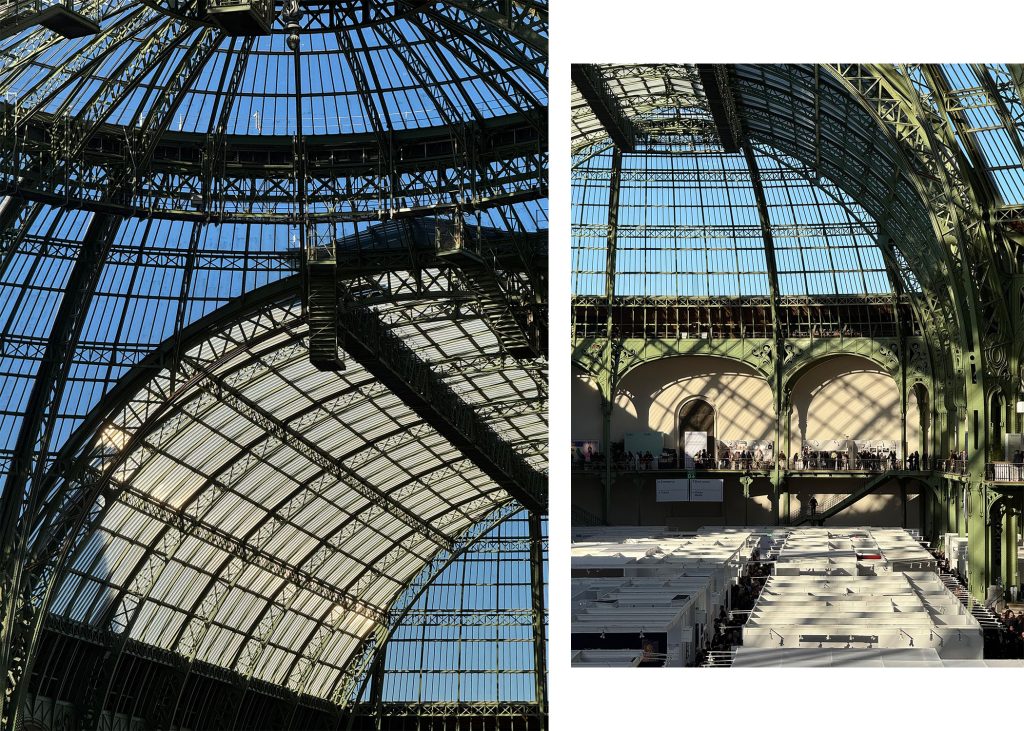
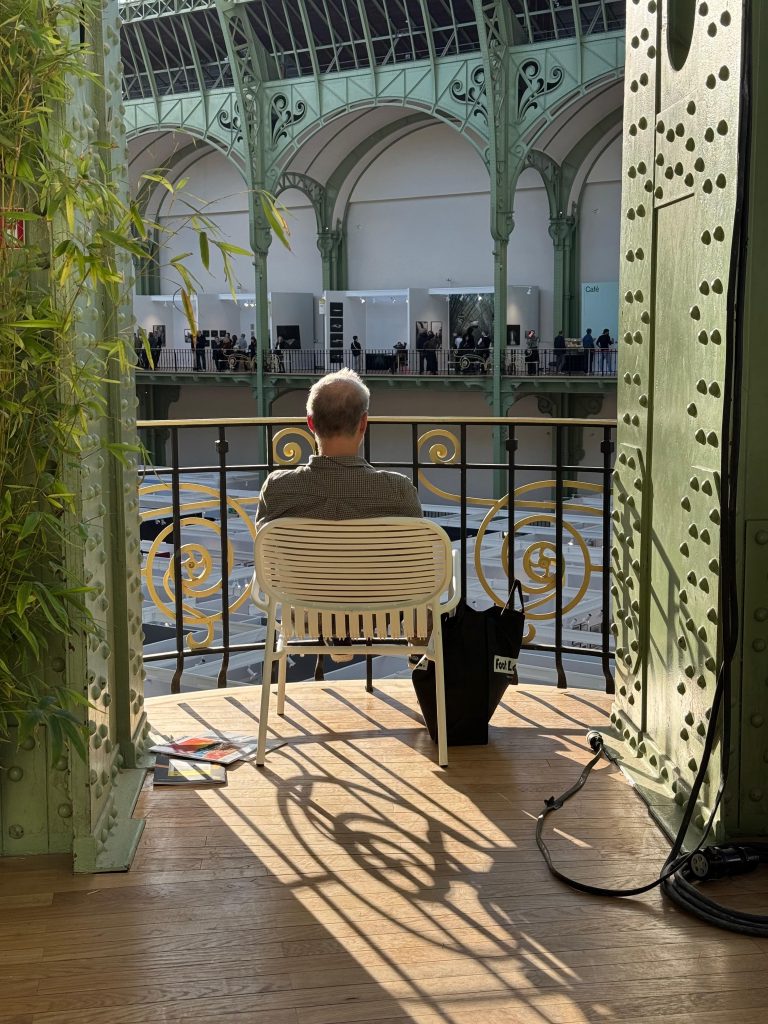
The real revelation comes upstairs. Climb to the first-floor balcony, look down, and the fair rearranges itself into a scene from Jacques Tati’s Playtime: a grid of white cubicles, each a tiny self-contained world, with figures in dark coats drifting between them in slow, faintly bewildered loops. A man stops, leans towards a print, steps back, consults his catalogue, leans in again. Two women point at the same photograph and walk off in opposite directions. Somewhere, inevitably, someone is searching for the exit of the very booth they are standing in. Monsieur Hulot would have felt entirely at home, and would almost certainly have knocked over a frame.
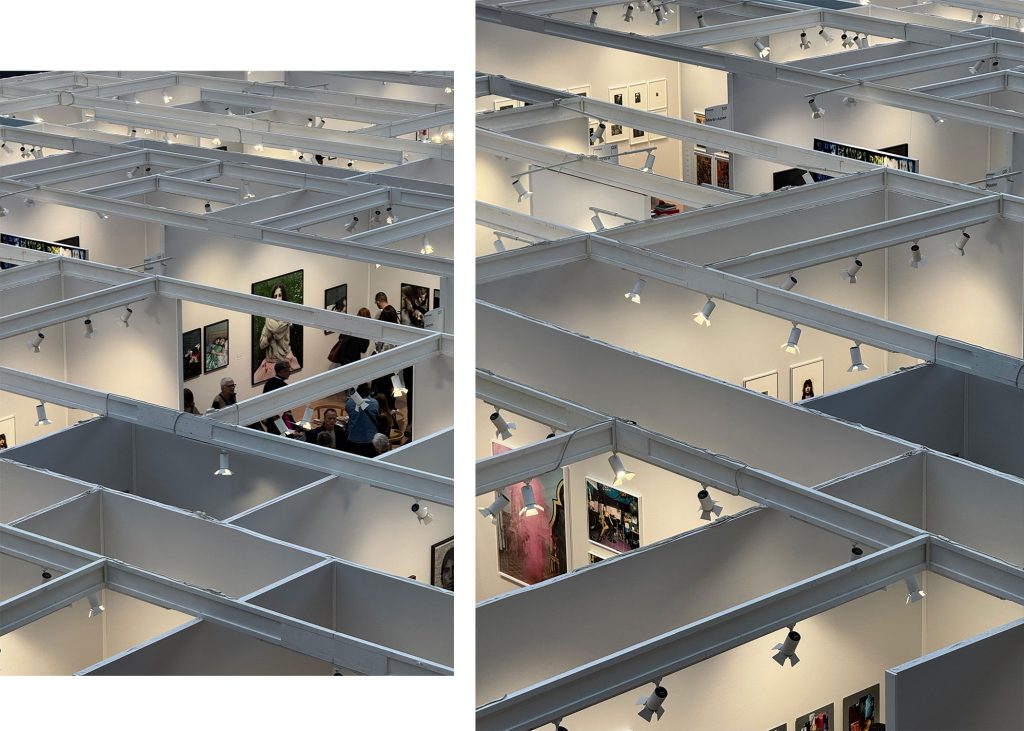
Watching from above, what struck me most was the simple, almost old-fashioned act of looking together. We consume more photographs than any generation in history, mostly in bed, thumb-first, at a rate of roughly one masterpiece every 0.4 seconds, wedged between a recipe and somebody’s holiday. Here, the pace changes entirely.
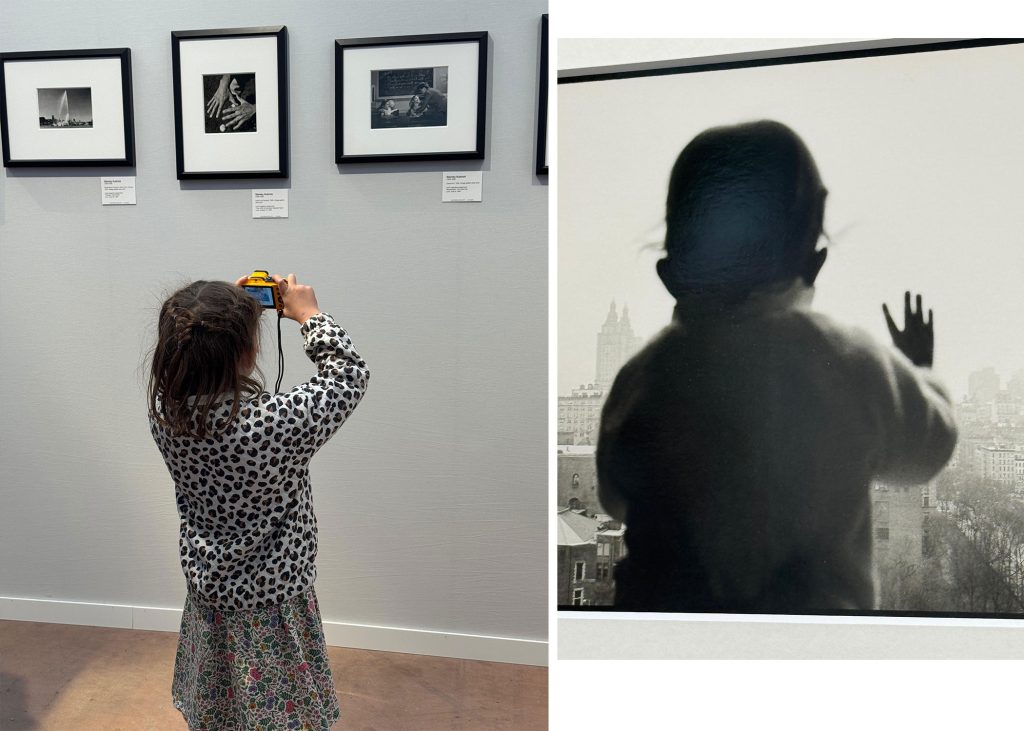
The hall hums at the volume of a good library, a low murmur in half a dozen languages broken only by the occasional sigh of recognition. People drift back to a print they passed an hour earlier, bring a friend to see it, point something out and simply stay. Conversations begin with a nod to a stranger and end with an exchange of Instagram handles, which may be the only truly acceptable use of a phone in the building. This is what photography is for: not the infinite scroll but the shared pause, the conversation that begins with “what do you see?” and ends three coffees later.
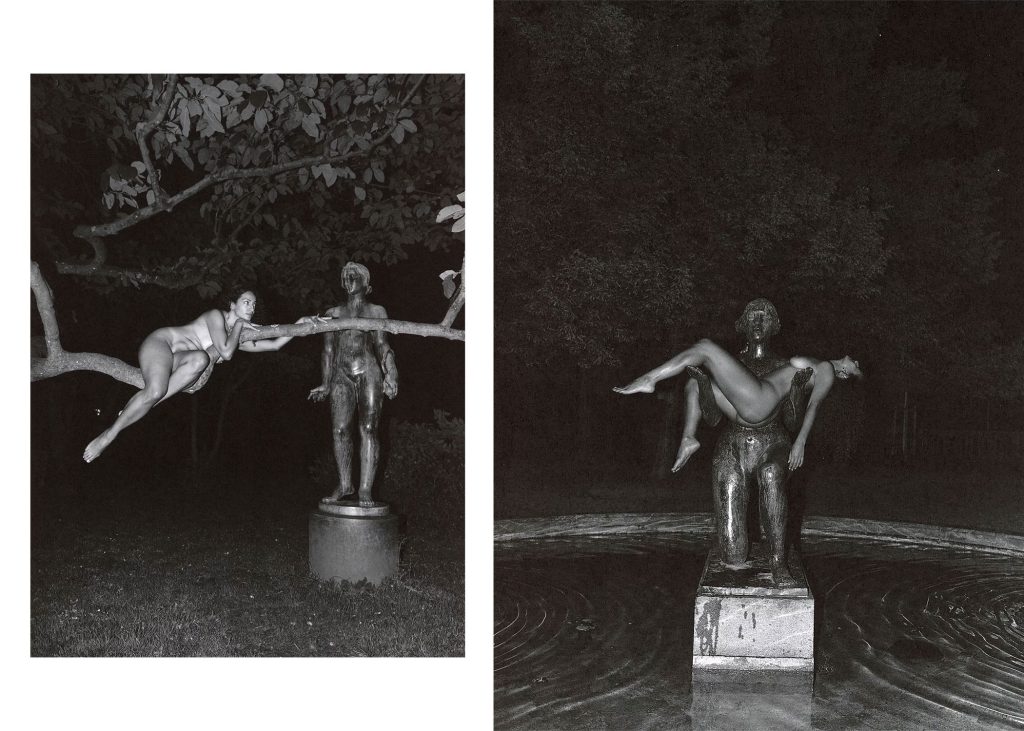
And then there is the work itself, which is the reason for all of this. Among so much that rewards a long look, one series stood out for its clarity of purpose: Yumna Al-Arashi’s Let Me In. Al-Arashi poses nude in the kind of sculptural stance usually handed to marble heroes and bronze generals, and quietly claims it for herself. It is a simple move that lands like a slammed door. She has said that choosing how she appears is both her greatest political act and her rebellion, and you feel the weight of that choice in every frame: not a woman asking permission to be seen, but one setting the terms. In a fair devoted to the art of looking, it is bracing to meet work that looks straight back.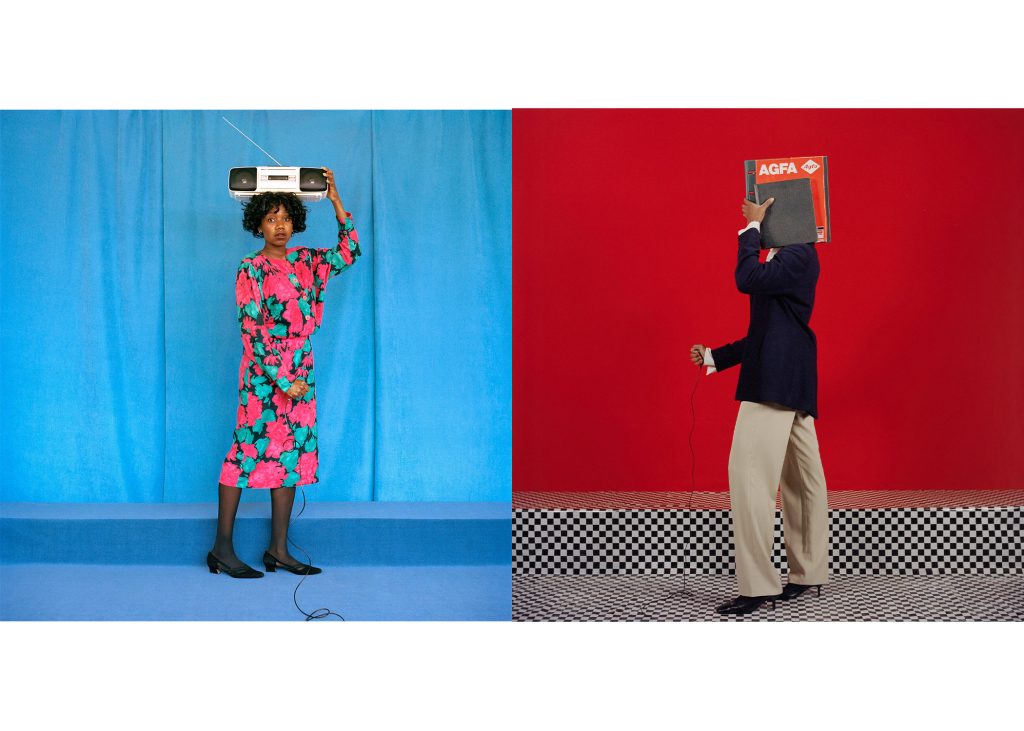
Self-portraiture of a different kind awaits at Southern Guild, in the work of Silvia Rosi. The Italian-Togolese artist turns the camera on herself to explore family, memory and migration, drawing on the rich tradition of West African studio portraiture. Her images are warm, composed and quietly searching, the kind that reward a second and third visit. Of all the pictures on show, hers ask one of the most enduring questions of all: where do we come from, and who gets to tell that story?
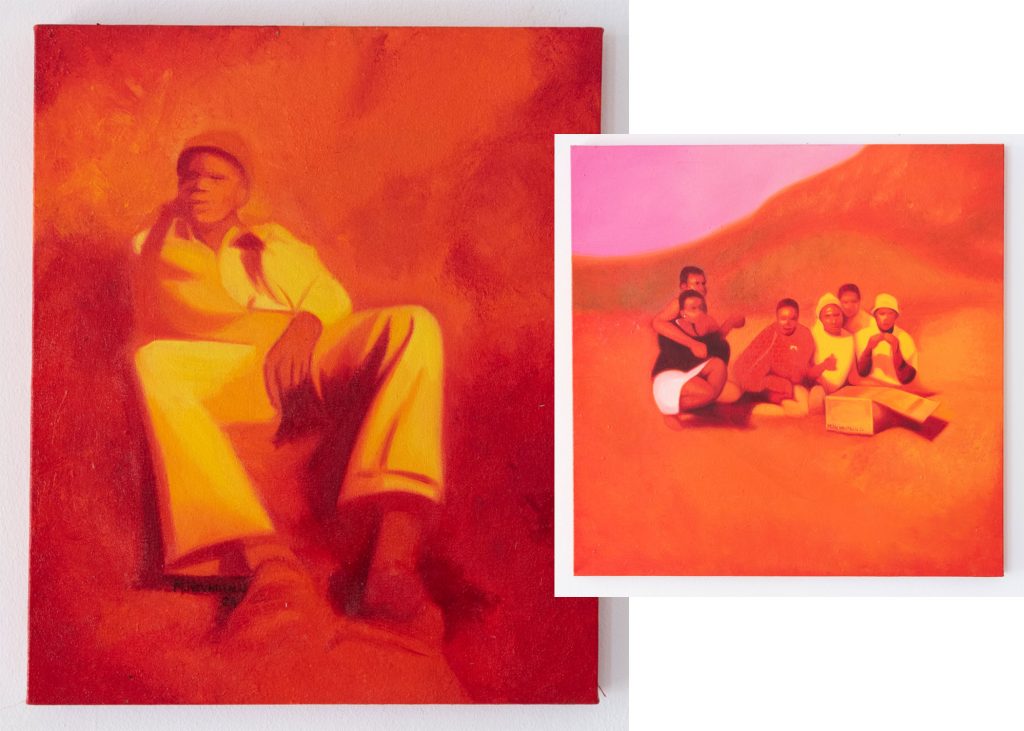
Family and memory take another turn at Johannesburg’s AFRONOVA Gallery, which makes an equally compelling case for lingering with Mashudu Nevhutalu, whose contribution to a photography fair is, delightfully, a wall of paintings. Look closer, though, and the camera is everywhere. Nevhutalu works from old family photographs, and his canvases keep their poses and framing: a young woman in sunglasses and white shorts standing against a crimson hillside, a man lounging in yellow, a cluster of friends crouched around a cardboard box as if waiting for the shutter to click. Each scene burns in molten reds and oranges beneath skies of acid lime and pink, like snapshots left a little too long in the sun. In one, the image sits on raw, frayed canvas, its edges dissolving into nothing. It is a fitting gesture for work that, in the artist’s own words, reflects on memory, home and the ways images preserve moments even as their details begin to fade. Among so many pristine prints, it is a tender reminder of how fragile a photograph can be.
Randa Mirza
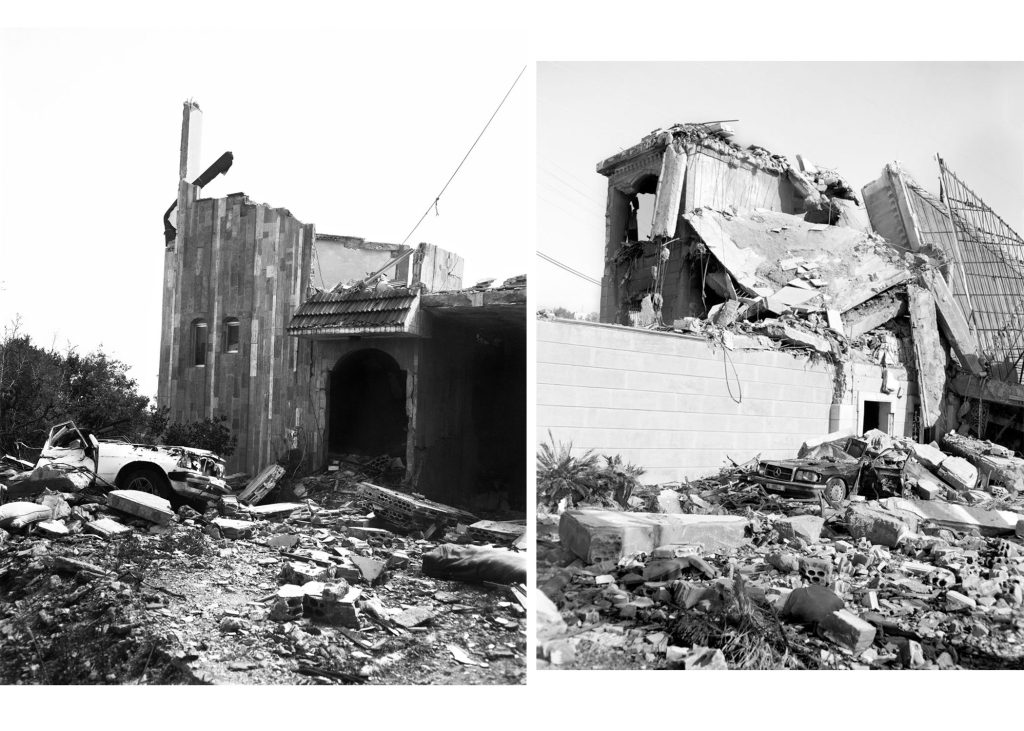
If Nevhutalu’s paintings hold on to home, Randa Mirza’s photographs mourn its loss, and they ask you to lower your voice. At Galerie Tanit, Mirza presents Atlal, a series that revisits the ancient Arabic poetic motif of ruins, long a symbol of loss, longing and the passage of time, through the lens of contemporary conflict. The series is an unflinching denunciation of the destruction of civilian homes in southern Lebanon by the Israeli army, and of the erasure of memory and history that comes with it. In one black-and-white print, a stone-clad house stands half-gutted beneath a pale sky, its arched doorway opening onto darkness, a tiled awning still clinging to the façade. In front, a white car lies crushed among the rubble and breeze blocks, while the trees beside it carry on growing as if nothing has happened. There is no spectacle here, only the stubborn, ordinary details of a home that was, recorded with clarity and restraint. The old poets stopped at the ruins to weep; Mirza stops to make sure we see them. Amid the bustle of the fair, it is a sobering reminder of what photography can still do: bear witness, and insist that we look.
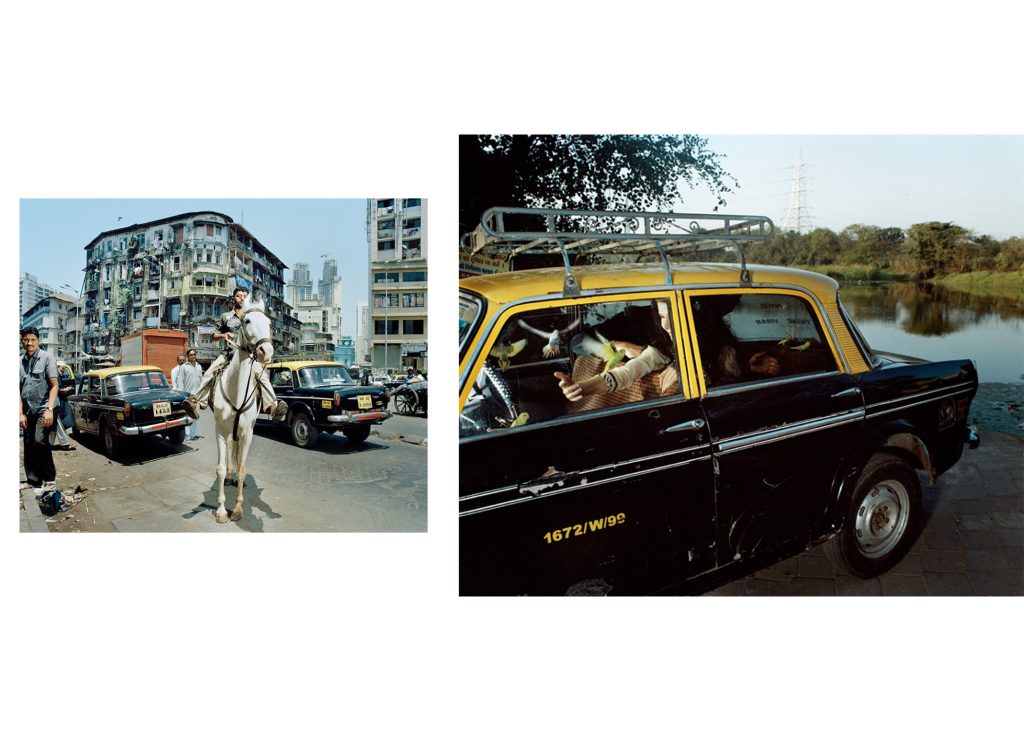
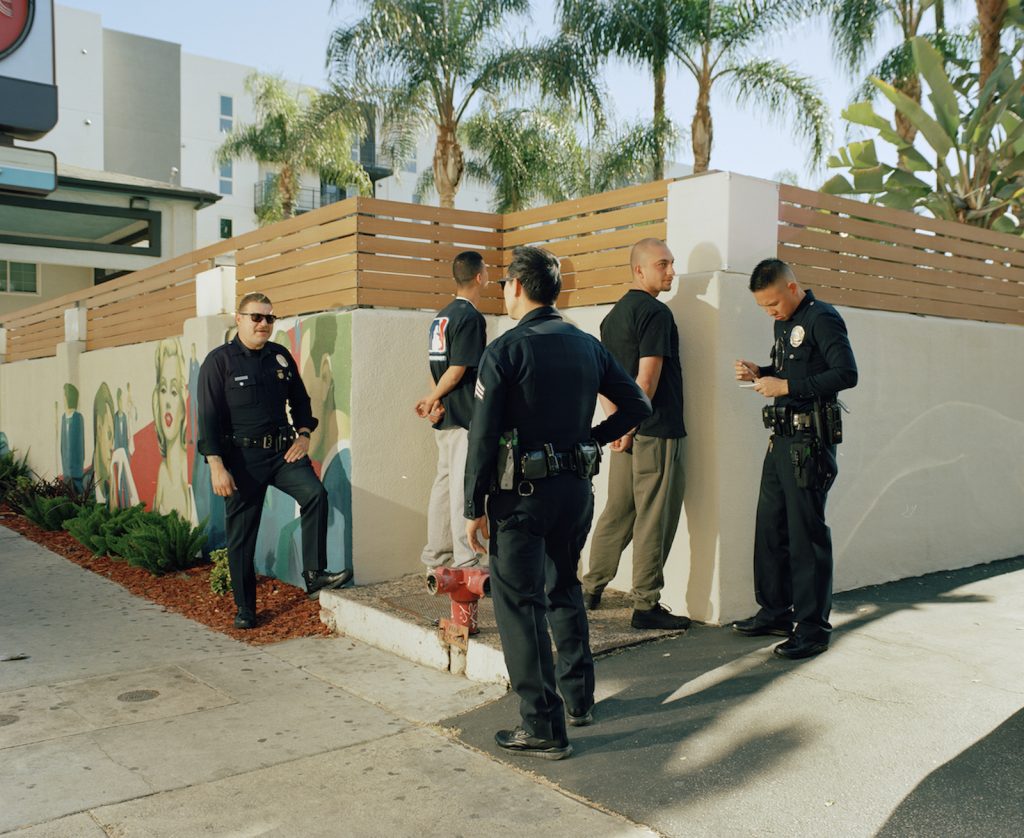
Over at Gallery Sofie Van de Velde, Max Pinckers’ solo booth changes the register completely, gathering a constellation of vivid scenes from several series made over fifteen years, a kind of map of his visual world. In one, a young man rides a white horse straight towards the camera through a Mumbai street, flanked by two black-and-yellow taxis and a crumbling tenement, while a bystander at the edge of the frame eyes us with mild suspicion. In another, green parakeets flutter inside a battered cab parked by a river, a passenger’s hand poking from the window as if mid-conversation with the birds. Pinckers has always delighted in the blurry line between the staged and the found, and his pictures are glorious puzzles: theatrical, tender, a little absurd, and impossible to walk past.
Max Pinckers
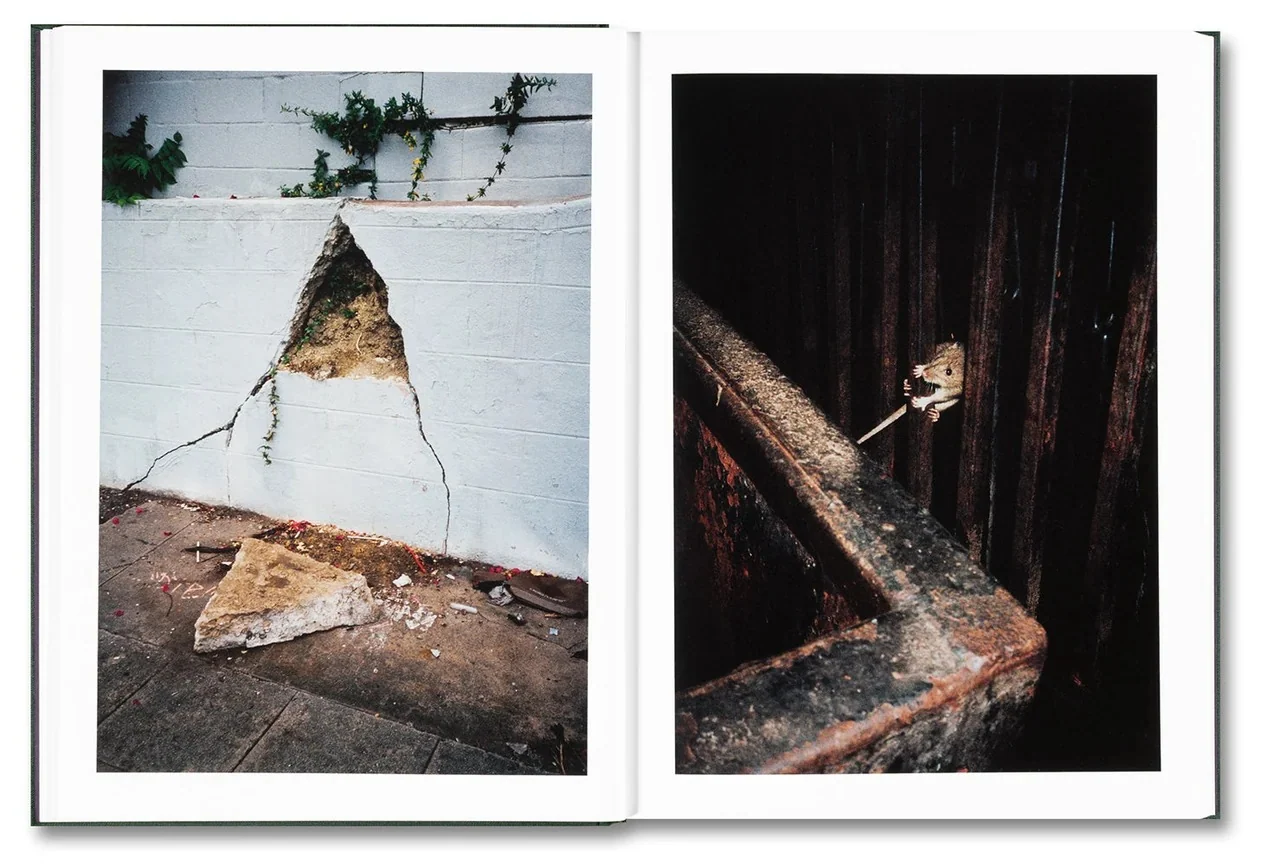
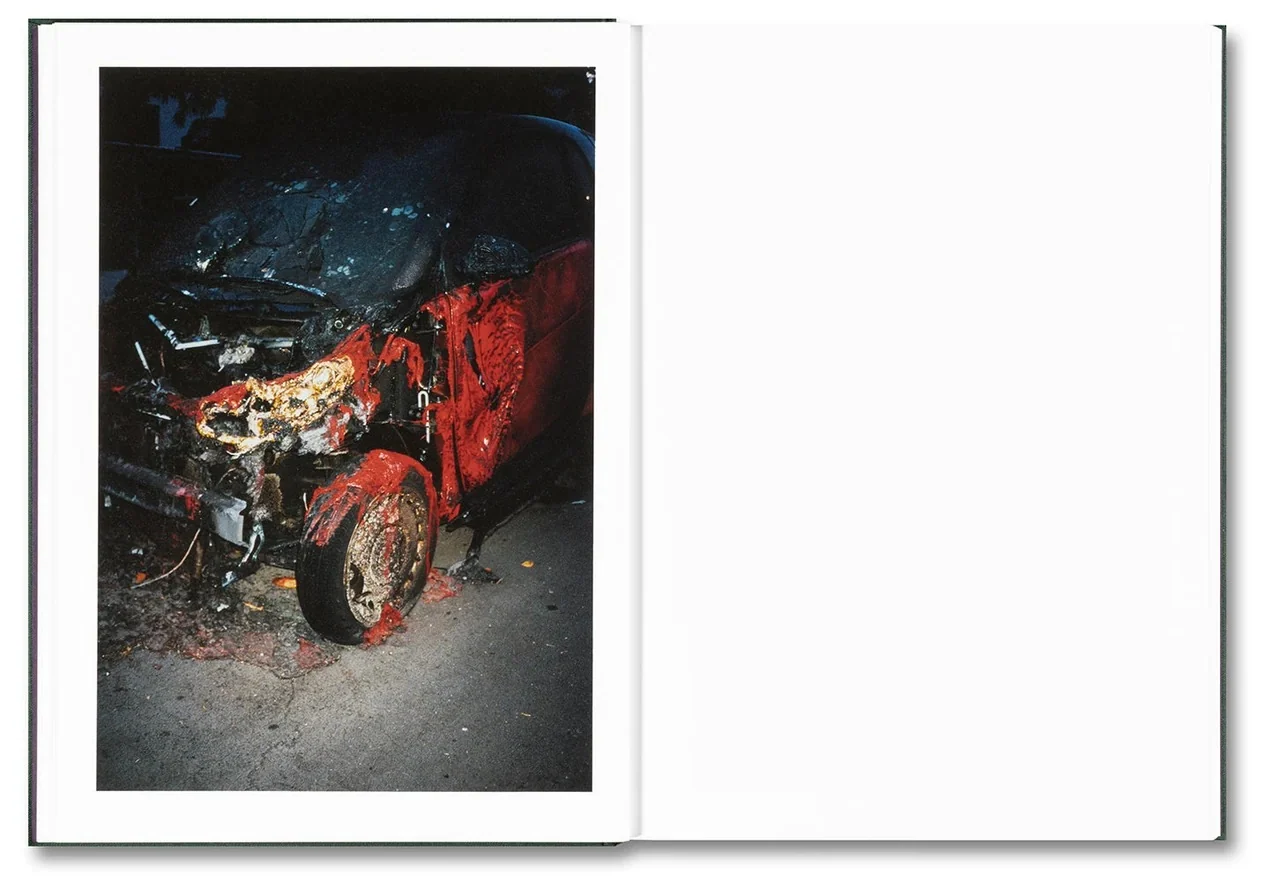
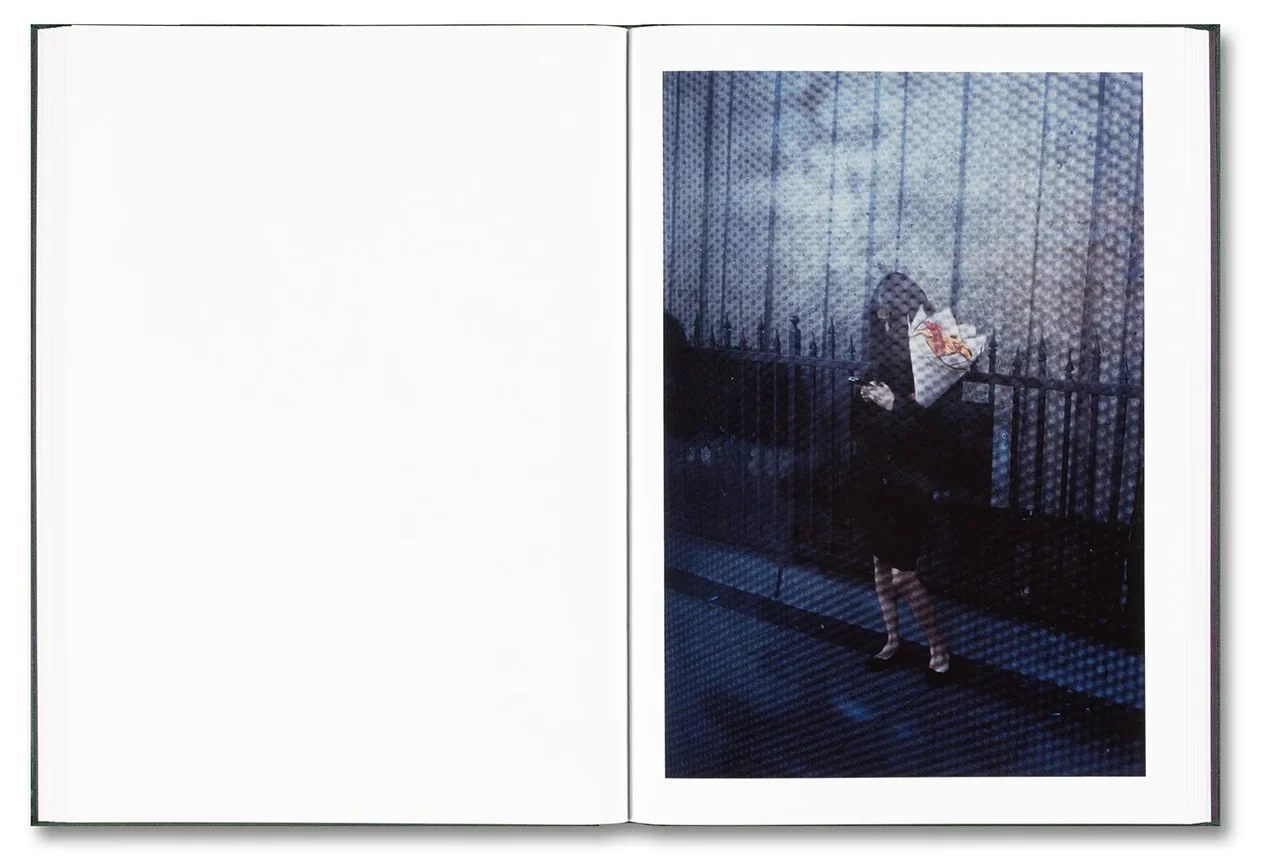
Not everything worth seeing at Paris Photo hangs on a wall, of course; some of it comes bound between covers. Two of the fair’s most welcome arrivals were new titles from Jerry Hsu and Cole Barash. Hsu’s How About Never gathers more than a decade of pictures made in Los Angeles, and treats the city almost as a living, breathing character in its own right. Hsu’s famously sharp eye for the absurd is still very much in evidence, but here it is tuned to the contradictions of contemporary America, with hope and despair, beauty and pain tangled together in a sequence that is atmospheric and quietly uncanny. Even the title has a perfectly deadpan shrug to it.
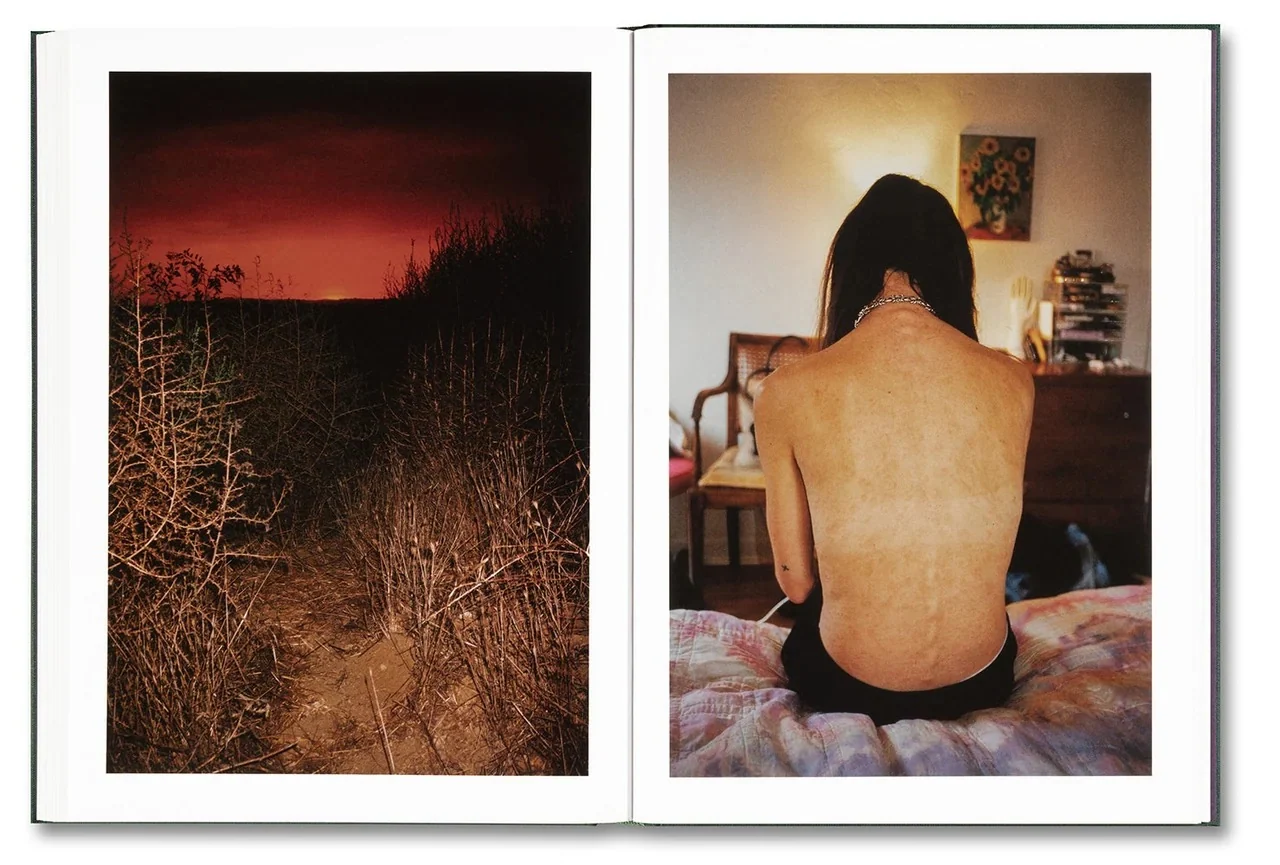
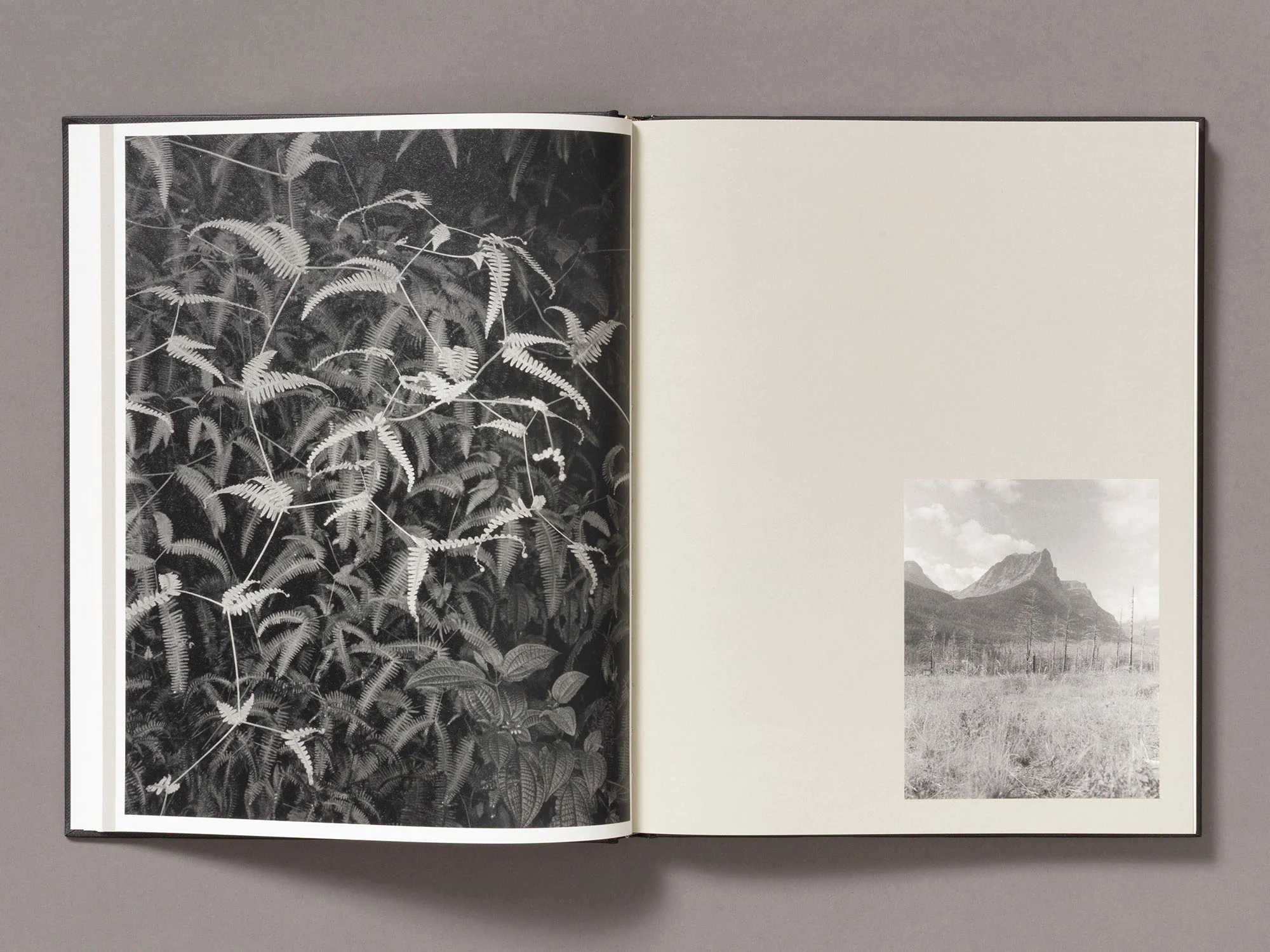
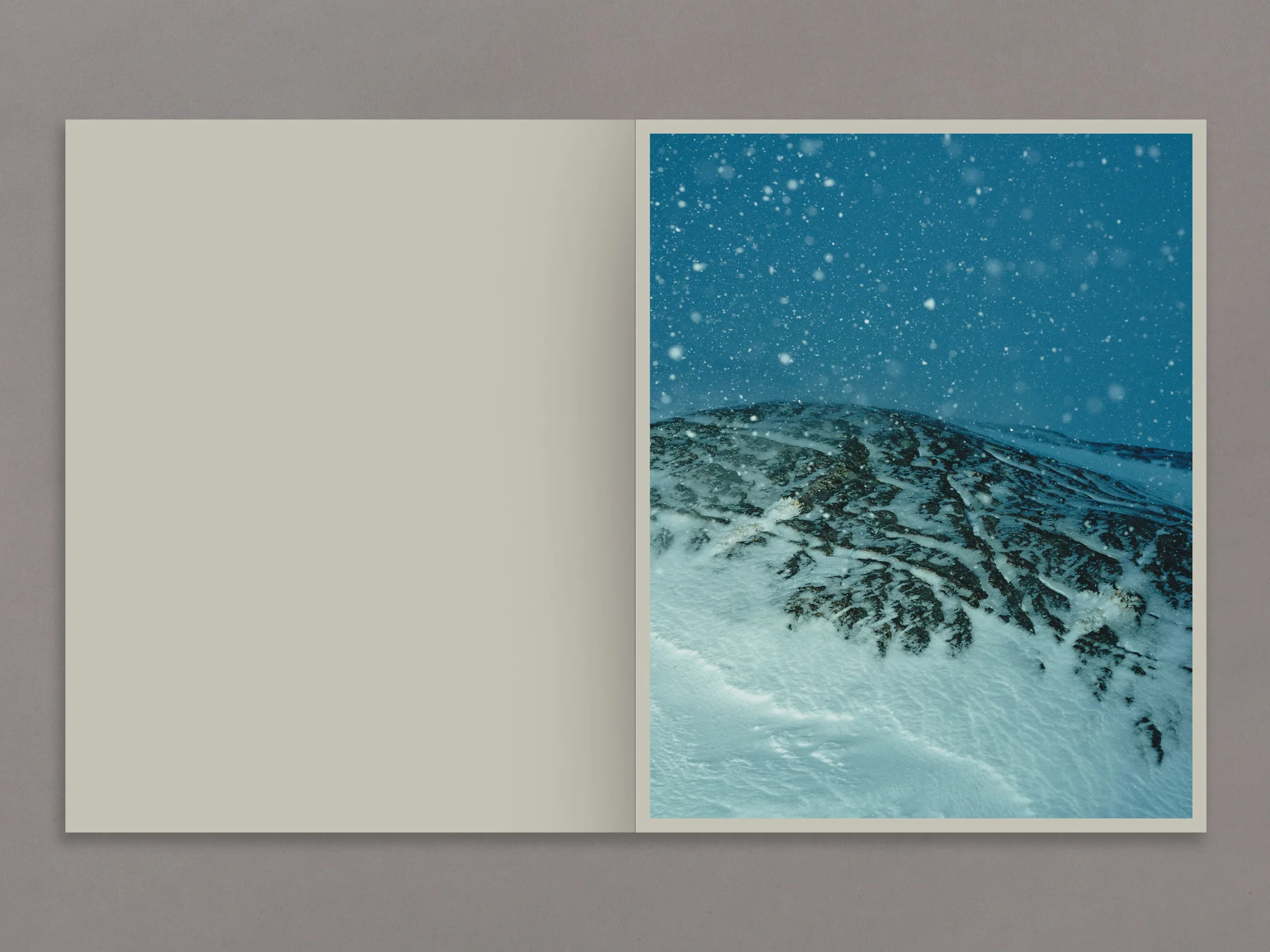
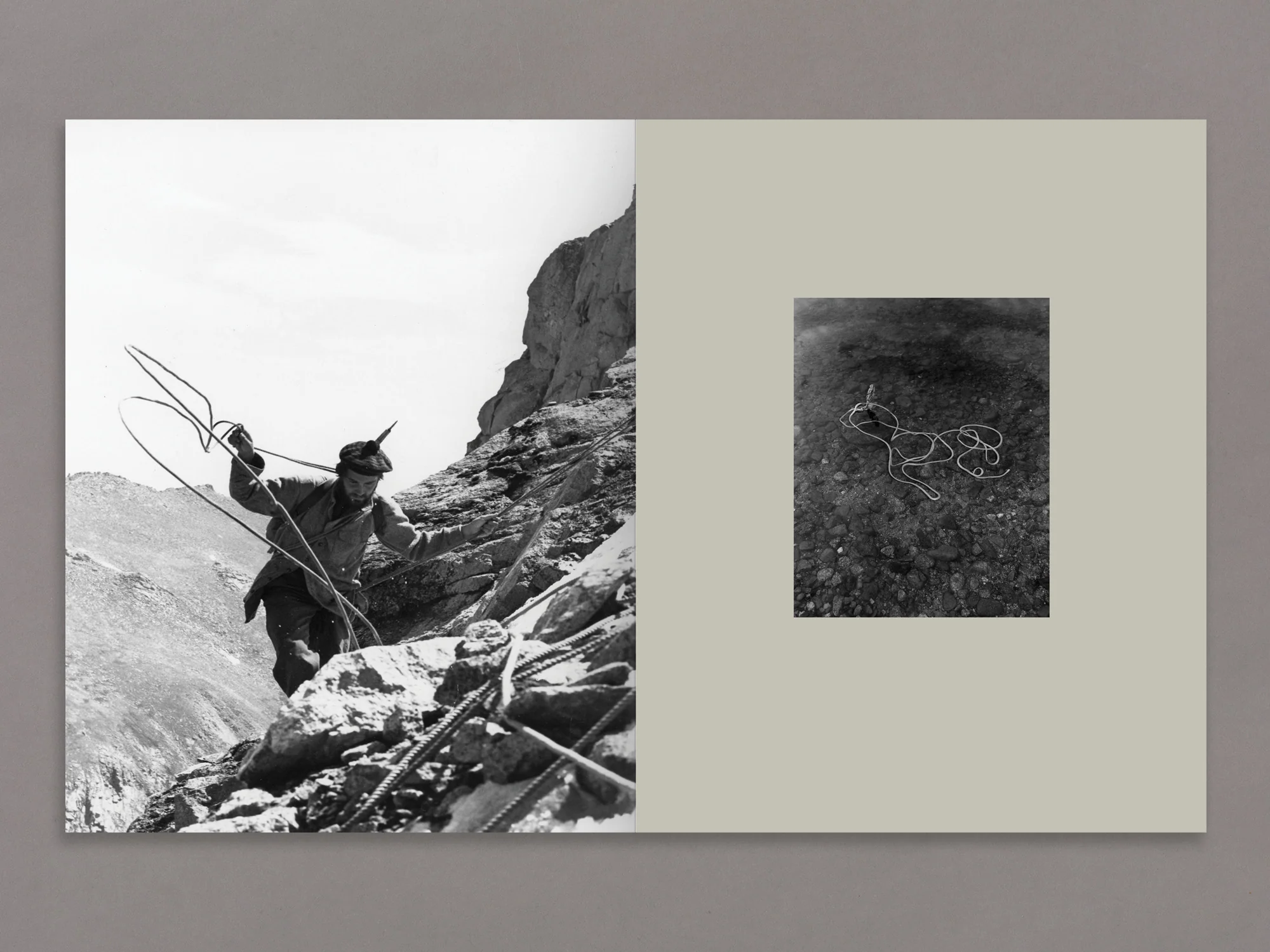
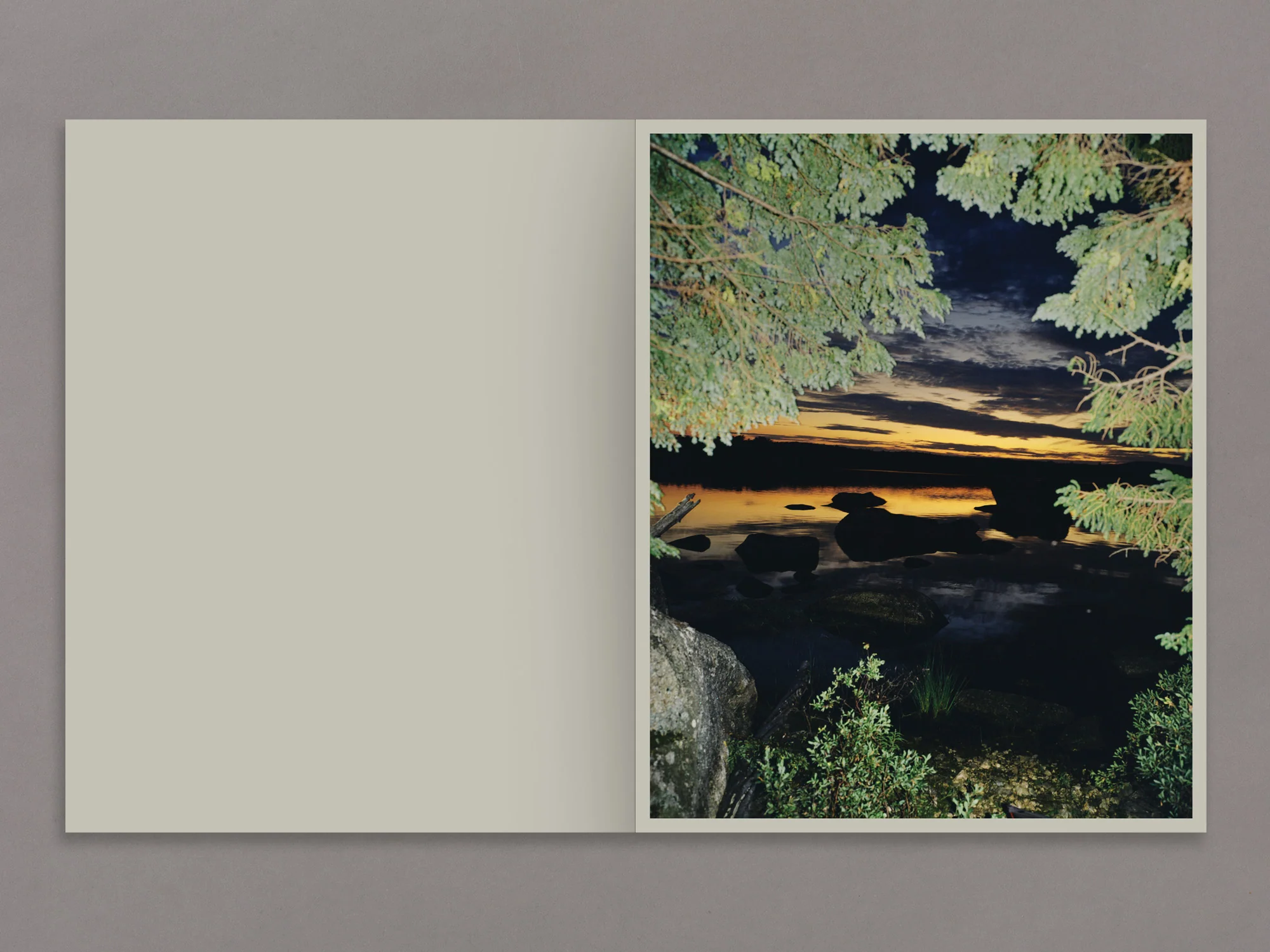
Cole Barash’s When the Wind Blows North is a quieter, more personal affair. Begun after the death of his father, it started as Barash retracing the wilderness routes his father once travelled, and grew over five years into something larger: a meditation on how photographs, landscapes and family histories keep reshaping one another. Shot across the American West and Northeast, his own pictures sit alongside silver gelatin prints from his father’s archive, images made decades apart and placed in quiet conversation. There is no neat narrative, only recurring forms, shifts in scale and visual echoes, so that two generations of looking come to share the same horizon. It is a book that rewards patience, and asks you to slow down in exactly the way a fair like this one does. Both books feel right at home here: a photobook is the original antidote to the scroll, something to hold, leaf through slowly and press into a friend’s hands.
All that looking, and all those pages, eventually take their toll. It is exhausting, naturally, though in the best possible way. By mid-afternoon the soles of the feet are lodging formal complaints and the brain has begun rendering everything in silver gelatin. One seeks refreshment. A modest flute of champagne is €20, received with the appropriate Gallic shrug; such is life in Paris during a cost-of-living crisis. One sips slowly, and makes it last at least two booths, until the pull of the next picture proves impossible to resist.
Then back into the grid, back into the glow, among the other drifting figures, looking. Paris Photo 26 is a glorious abundance, as ever. Long may it remain so.